
Human metabolite profiles in early-stage drug development
Ultra-sensitive quantification of radiolabeled parent drug and its metabolites via combined UPLC+AMS technology. High quality metabolite profiles can be generated using only 1 mBq of radioactivity, allowing individual metabolites to be quantified to levels as low as 10 µBq. Due to the low level of radioactivity, microtracer 14C-studies are considered ethical from Phase 1. The early-stage insights in human metabolites help you to make the right decisions for later-stage development.

Enrichment of your early-stage total radioactivity data with metabolite profiling using AMS
Metabolite profiling quantifies the abundance of the parent drug and its metabolites via UPLC in combination with AMS. Parent drug and drug derived metabolites may have potential toxicological implications. Early insights enable timely risk mitigation strategies for unexpected human metabolites. Furthermore, early-stage human metabolite profiling via AMS eliminates the need for conducting radioactive animal mass balance and metabolite profiling studies, saving animals, time and money.
Our team of scientists will support you in decisions on the optimal position of the radiolabel(s) and dosing level for mass balance and metabolite profiling studies. For complex small molecules, multiple radiolabels may be required to map all relevant human metabolites. Our team will provide recommendations based on scientific insights and practical experience.
Situations where early-stage metabolite profiling adds value to your drug development program
Human metabolite profiling is an essential part of any drug approval submission. Regulatory authorities encourage studying metabolite profiles as early as possible in clinical development.
Metabolic toxicity is a concern
The expected metabolism routes of your early-stage clinical asset may lead to unwanted toxicities
Biotransformation is complex
The complexity of your small molecule or peptide warrants extensive investigation of biotransformation
Drug interactions are suspected
Your small molecule compound is entering Phase 1 and you suspect that metabolites may cause drug-drug interactions
Human metabolites are expected
Your preclinical data indicates the formation of relevant human metabolites after administration
A prodrug is being developed
You are developing a pro-drug that is metabolized into its active form after administration
Practical study information for absolute bioavailability
| Parameter | Peregrion Approach | Client Benefit |
|---|---|---|
| Typical cohort size | 6-8 participants | limited number of participants |
| Sample matrices | whole blood, plasma, urine, feces, exhaled air, bile and vomit | full quantitative picture of metabolite abundances per matrix |
| Sensitivity range | UPLC + AMS enables accurate quantification of metabolites with abundances as low as 1% | complete picture of all human metabolites, including the minor with potential pharmacological effects |
| Accuracy | AMS LLOQ is around 10 µBq/fraction, which is 100x lower dose and 500x better sensitivity than LSC | applicable for low dosage drugs, drugs with long half-life, long living metabolites, drugs with slow excretion |
| Radiation dose | ≤ 1 µCi; 100-1,000 lower than conventional studies | studies are approved as early as Phase 1, as the radiological exposure falls in ICRP Class I due to the low radiological exposure |
| Match of spectra | a single injection for metabolite quantification and identification by coupled UPLC-hrMS/MS + AMS system | 100% match between AMS and hrMS data; no issues with shifts in retention time |
| Study design | recommendations on position of radiolabel(s) and microtracer dosing | scientist to scientist interactions resulting in optimal study design for evaluating drug metabolism and excretion |
Combined analysis of total radioactivity and metabolites can be done from a single sample
Add metabolite profiling and identification to your mass balance studies using the same sample. Integrated results are generated from a single injection by coupling UPLC-hrMS + AMS systems.
Benefits of combining studies
- Eliminate the need for animals, time and money on animal metabolism studies
- Full mass balance and metabolite data package from a single sample
- 100% match between metabolite identification and quantification
- Decreased interindividual variability
- Excretion results can be directly coupled to the metabolite profile

Why Peregrion for human metabolite profiling services
Guided by Scientific Experts

Esther van Duijn
Esther has a background in analytical chemistry and holds a PhD in (native) mass spectrometry. She has more than 10 years of experience as a scientist in AMS. She drives technological advancements for existing and new applications and focusses on scientific growth, quality and teamwork.

Jelle Reinen
Jelle has a background in pharmaceutical sciences and holds a PhD in molecular toxicology. He has worked as a Study Director in the pharmaceutical industry since 2015. He has 3 years’ experience in the AMS field with his main focus on metabolite profiling and identification and absolute bioavailability studies.

Ioana Barbu
Ioana has a background in analytical chemistry and physics and holds a PhD in mass spectrometry. She has 5 years experience as a scientist in AMS with her focus on metabolite profiling/identification, mass balance and absolute bioavailability studies

Related Services
Absolute Bioavailability
Information on absolute bioavailability can help interpret mass balance data and understand the overall drug elimination pathways. For instance, if a large fraction of the drug is found unchanged in feces, bioavailability data supports understanding of the role of biliary and/or gut wall secretion to drug elimination.
Metabolite Profiling
Information on absolute bioavailability can help interpret mass balance data and understand the overall drug elimination pathways. For instance, if a large fraction of the drug is found unchanged in feces, bioavailability data supports understanding of the role of biliary and/or gut wall secretion to drug elimination.
Metabolite Profiling
Information on absolute bioavailability can help interpret mass balance data and understand the overall drug elimination pathways. For instance, if a large fraction of the drug is found unchanged in feces, bioavailability data supports understanding of the role of biliary and/or gut wall secretion to drug elimination.
Feces homogenization
Information on absolute bioavailability can help interpret mass balance data and understand the overall drug elimination pathways. For instance, if a large fraction of the drug is found unchanged in feces, bioavailability data supports understanding of the role of biliary and/or gut wall secretion to drug elimination.

Resources & Publications
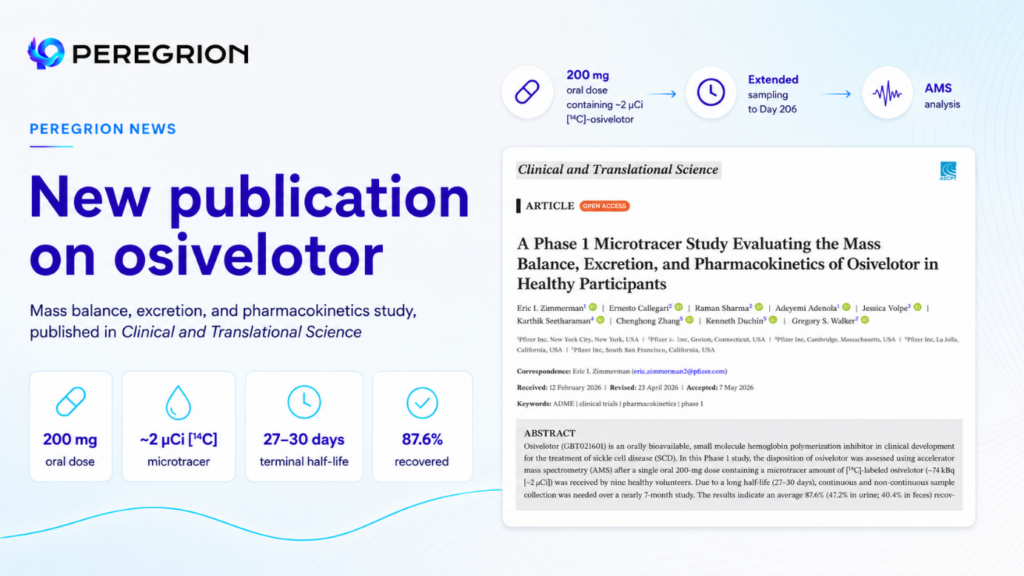
New publication on a long-duration microtracer ADME study of osivelotor
A newly published Phase 1 study shows how microtracer dosing and AMS enabled the characterisation of osivelotor’s mass balance and…
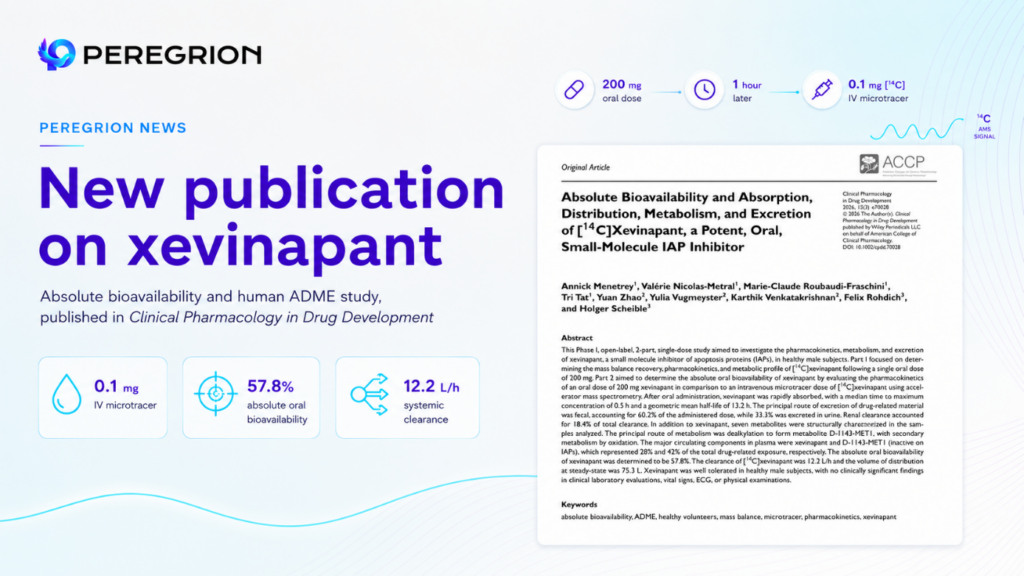
New publication on xevinapant absolute bioavailability and human ADME
A Phase 1 study on the absolute bioavailability, pharmacokinetics, metabolism and excretion of xevinapant has been published open access in…
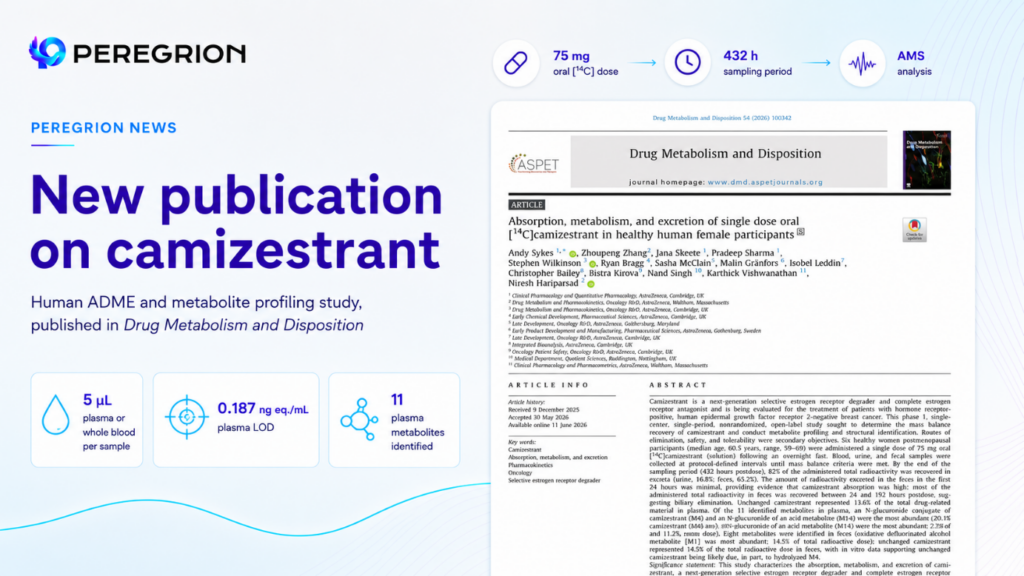
New publication on the human ADME and metabolite profile of camizestrant
A newly published Phase 1 study shows how AMS enabled total-radioactivity analysis from 5 µL samples and detailed metabolite profiling…
Support
FAQs
How do I start a microtracer study with Peregrion?
That’s easy. Contact us via the Contact Page on the website or reach out to your existing contact person at Peregrion. After initial exploratory conversations, we can arrange a CDA to freely talk about the project and your needs, and suggested steps forward. Our scientists will be involved at an early stage to develop optimal study designs. After submission and approval of our proposal we will agree on a Study Agreement or Master Services Agreement. Your dedicated Project Manager will then guide you through the practicalities of getting started. When there is clarity on the dosing date(s) we will reserve time slots in our facility. You can contact us any time, we are happy to help.
What type of excreta are used in radiolabeled studies?
Total radioactivity measurements are done with human plasma, urine, whole blood, feces, exhaled air, bile and vomit. Very low sample volumes are required, i.e. 5 uL of plasma for a total radioactivity analysis and 50 uL of plasma for the generation of PK data or metabolite profling data. Samples are introduced via an automated sample combustion device that generates CO2, which is directed to the AMS via an interface. A single sample is completed in less than 10 minutes. The speed of the analysis supports discharge studies from a clinical site. You will receive the study results within 48 hours after sample receipt.
Which data can be generated with Peregrion’s AMS-enabled studies?
- Absolute bioavailability data
- PK profile (for parent drug and known metabolites)
- Metabolite profile including metabolite identification
- Mass balance data
- Routes of excretion
- Information on the first pass effect
- Fraction absorbed
- Volume of distribution
What is a microdosing study in the context of a microtracer study?
A microdosing study includes a very low dose of the drug product (e.g. 100 µg) with a 14C microtracer. Due to the low dose (considered as an impurity) there is no toxicological concern and only a limited pre-clinical package is required to conduct such a study. This comes with the advantage that fewer lab animals are needed. Multiple drugs can be administered in the same study in parallel groups to aid in PK based candidate selection. A typical microdosing study consists of approximately 6 volunteers per drug. The microdose can be administered via any route, e.g. oral or intravenous.
Is human ADME data that is generated with microtracer studies acceptable for regulatory submissions?
The answer is ‘Yes’. We deliver data to our clients to support their regulatory submissions with regulatory-required or requested data such as human metabolism, routes of excretion, absolute bioavailability, and fraction absorbed. The FDA guideline on Safety Testing of Drug Metabolites Guidance for Industry (CDER) March 2020 Pharmacology/Toxicology recommends performing human in vivo metabolic evaluation as early as possible. The level of radioactivity in a microtracer study is only 0.1-1µCi. Conventional studies generally apply 100µCi. Due to the 100-fold lower radioactivity levels, ethical committees approve the use of 14C microtracers in early stage clinical development.
Why is 14C labeling required for safety studies?
Incorporating radioactivity in the drug molecule is needed to ascertain that all metabolites will be found in the systemic circulation. Since virtually all drugs contain carbon, the highest scientific standard practice is to synthesize the drug with incorporation of radioactive carbon-14, and to dose this radioactive material to a small number of healthy participants or patients in a hADME study. Samples from excreta and blood or plasma can be analyzed to trace the drug and its metabolites. Analysis via AMS is up to 10,000-fold more sensitive than classical methods, for instance Liquid Scintillation Counting (LSC) and therefore very small amounts of radioactivity are sufficient.
What are the combined advantages of microtracer studies in clinical development?
Overall, the microtracer-based mass balance, metabolite profiling and absolute bioavailability studies in early clinical developments give an enormous enrichment of the data package available at early stage without the need for separate studies to determine human ADME data. The data richness allows better study designs for follow up clinical studies, it allows earlier assessment and risk mitigation strategies for unexpected human unique metabolites, and it eliminates the need to conduct radioactive animal mass balance/metabolite profiling studies, where many animals, and much time and money are being spent on non-relevant animal metabolites.